
There are plenty of days when surf data is just numbers on a screen.
Today at Trestles, those numbers have a pretty good audience.
With WSL competition underway at one of Southern California's most famous waves, Killer Surf Links is currently giving the swell at Trestles a perfect 10.0 Surfability Score™.
That's not a prediction. That's what the Surfability Score is seeing right now.
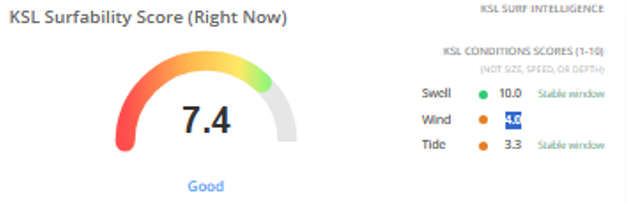
At the latest KSL update, the overall Trestles Surfability Score™ is 7.4 out of 10, rated Good, but tucked inside that overall number is something much more interesting: the swell component is scoring 10.0.
And with some of the world's best surfers in the water, that's a pretty fun number to put to the test.
The current swell is running roughly 3 to 4 feet from the south-southwest with 14-second energy. KSL calculates approximately 448 kJ of swell energy, with the primary swell arriving around 195 degrees.
That's important at Trestles.
The swell isn't simply big enough to surf. Its direction is sitting inside the break's ideal directional window, meaning Trestles is positioned to make good use of the energy that's available.
That's the idea behind Surfability Score™. A 4-foot swell isn't equally valuable everywhere. Direction, period, wind, tide, and the personality of the break determine how much of that offshore energy ultimately becomes surfable wave quality.
Right now, the swell and Trestles are speaking the same language.
Swell Score: 10.0.
Because good swell doesn't get the beach to itself.
At the same update, KSL is scoring the wind at 4.0 and the tide at 10.0. Those conditions are holding the overall Surfability Score down to 7.4, despite nearly ideal swell conditions.
The wind is coming from the south at approximately 5 to 10 mph, introducing some cross-shore influence and texture to the surface. It's not enough to destroy the surf, but it's enough to keep conditions from being as clean as they could be.
The tide is also less than ideal.
KSL shows the tide around 3.53 feet and rising, with the next high approaching 4.6 feet. That's getting toward the higher end of what Trestles prefers, which can soften the wave and reduce some of its consistency and quality.
This is exactly why Surfability Score isn't simply a swell meter.
You can have an excellent swell and mediocre conditions. You can also have beautifully clean conditions without enough swell energy to make them matter.
Surfability happens when the pieces come together.
That's what makes today's WSL competition particularly interesting from the KSL perspective.
Normally, we're comparing the Surfability Score against what surfers are reporting, nearby observations, and other available surf information. During a major professional contest, we essentially have the world's best surfers providing a live demonstration of what the ocean is producing.
KSL doesn't know who's winning a heat.
It doesn't know whether a surfer just threw a huge turn, got caught behind a section, or found the wave of the day.
The scoring engine is simply looking at the conditions affecting Trestles and asking the same question it asks at every break:
How surfable is this beach right now?
Today the answer is 7.4 overall, with the swell itself pegged at 10.0.
Trestles also illustrates why Killer Surf Links is being built one break at a time.
Surfability Score™ isn't designed around the idea that one set of conditions works everywhere. Each break has its own relationship with swell direction, swell energy, period, wind, and tide.
Trestles happens to be receiving a south-southwest swell today that lines up very well with what the break likes.
Move that same swell somewhere else along the Southern California coast and the result could be completely different.
That's the beach's personality.
KSL's job is to understand enough of that personality to turn a bunch of disconnected measurements into something useful to a surfer.
There's something especially satisfying about seeing the Trestles swell meter sitting at 10.0 while a WSL competition is happening on the same waves.
The overall conditions aren't perfect. The wind could cooperate more. The tide could be better positioned.
But the swell?
According to the Surfability Score™, Trestles is getting exactly the kind of swell it wants.
And today, we don't have to take a computer's word for it.
The world's best surfers are out there testing it for us.
→ Check the current Trestles Surfability Score™ and Surf Report
 Killer Surf Links