Every surfer asks the same question before heading to the beach.
"How's the surf right now?"
It sounds simple, but every surfer knows the answer isn't.
A surf report can tell you the swell is four feet, the wind is offshore, and the tide is rising. That's useful information, but it still leaves one important question unanswered.
Will those conditions actually produce good waves at my break?
That's what the KSL Surfability Score™ is designed to answer.
Instead of making you connect swell charts, wind reports, tide tables, and years of local knowledge in your head, the Surfability Score brings everything together into one simple rating. It measures how well today's current ocean conditions are lining up at a specific surf break, helping you make a faster, more confident decision before you go.
The Surfability Score is a break-specific rating that measures how rideable the waves are likely to be right now.
It's built on the idea of surfability, the relationship between the ocean conditions you can measure and the way a particular surf break reacts to them. Good surf isn't created by swell alone, or wind alone, or tide alone. It happens when those conditions come together at the right place and at the right time.
Experienced surfers have been reading the ocean this way for years. The Surfability Score simply follows that same thought process and turns it into something you can understand at a glance.
Every Surfability Score begins the same way an experienced surfer does. It starts by looking at the current ocean conditions at a specific surf break.
The score doesn't focus on just one condition because no single condition tells the whole story. Instead, it begins by evaluating four key factors that shape every surf session.
Without swell, there are no waves. But not every swell is a good fit for every break. The Surfability Score looks at the swell's direction, size, and period to determine how well it matches that particular spot.
Wind can make a good day even better or ruin it. Glassy conditions and clean offshore winds usually produce smoother, better-shaped waves, while onshore winds can quickly make the surf feel sloppy and less enjoyable.
Every break has a tide it likes best. Some come alive on a rising mid tide, while others need lower or higher water before they start working. The Surfability Score evaluates today's tide based on what usually produces the best waves at that break.
This is where current ocean conditions become Surf Intelligence.
Every surf break has its own personality. Reef breaks, beach breaks, and point breaks all react differently to the same swell, wind, and tide. A swell that creates excellent surf at one break may produce disappointing waves just a few miles away.
The Surfability Score is built around those differences. Instead of treating every break the same, it evaluates today's conditions based on how that particular break is known to work.
SS = (SH × SD × SP) (WS × WD) (TH × TM) × BI ± A
Swell × Wind × Tide × Break Intelligence ± Adjustments
No single condition tells the whole story. The Surfability Score brings these four factors together into one easy-to-understand rating. The result is a clearer picture of how well the current conditions are lining up before you decide to paddle out.
That's a fair question. After all, surfers have been making these decisions themselves for decades.
The Surfability Score isn't trying to replace that experience. It's built around it.
The score follows the same process experienced surfers naturally use every time they check the surf. It starts with the current ocean conditions, then asks a question many surf reports can't answer. How does this particular break usually react when these conditions come together?
The best way to understand the Surfability Score is to use it.
Check the score before you leave the house, then compare it to what you find when you get to the beach. After a few sessions you'll start noticing something interesting. The better you understand your local breaks, the more the score makes sense. The more you use it, the more you'll recognize the same patterns experienced surfers have been reading for years.
The Surfability Score doesn't replace your judgment. It helps you build it.
Every surfer has driven to the beach expecting good waves, only to find something completely different.
Maybe the swell looked perfect on paper, but the wind turned earlier than expected. Maybe the tide was wrong. Maybe another break down the road was working better.
The Surfability Score helps reduce that guesswork.
Instead of spending your time comparing charts, cams, forecasts, and tide tables, you can quickly see how today's conditions are coming together at your break. That means less time trying to figure out where to surf and more time doing what you came to do.
Surf.
Traditional surf reports describe the ocean.
The Surfability Score describes how your surf break is expected to respond to the ocean. That's an important difference.
The same swell can produce completely different waves at two nearby breaks. A good surf report gives you the data. The Surfability Score interprets that data using break-specific intelligence to help answer the question every surfer is really asking.
"How's the surf here?"
The ocean changes every day and every break changes with it. The Surfability Score was built to help surfers make better decisions by turning current ocean conditions and break-specific surf intelligence into one simple rating that you can understand in seconds.
You ask...How's the surf right now?
We say...Don't guess. Check the Surfability Score →
Add a clean, real-time Surfability Score to your website so visitors can quickly see how surfable conditions are right now at a selected break.
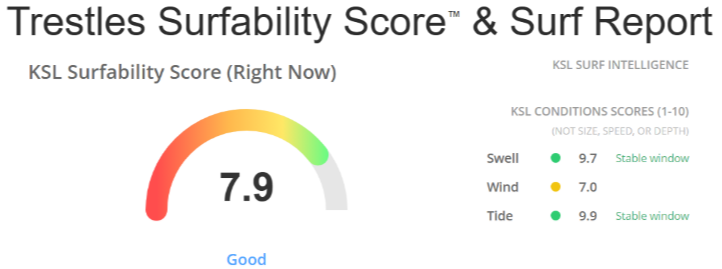
The widget displays the KSL Surfability Score along with swell, wind, and tide condition scores. It is lightweight, ad-free, and powered by KSL Surf Intelligence.
 Killer Surf Links